Tree trimming · Tyler, Texas
Five kinds of trimming, each with its own reason to cut.
Thinning, raising, reduction, deadwooding and vista pruning, chosen tree by tree by an ISA Certified Arborist rather than one standard haircut.
Thinning and raising change what the canopy lets through
Crown thinning is selective branch removal that lets light and air move through a dense canopy. Done well it takes out crossing and crowded limbs evenly through the crown and leaves the tree's outline alone. Done badly it strips the middle and leaves tufts at the tips. We keep thinning modest, well under a quarter of the living crown in one visit, so the tree does not answer with a flush of weak water sprouts.
Crown raising clears the lower branches for visibility or clearance: over a driveway, along a sidewalk, above a mower or a delivery truck, off a roofline. We lift gradually, because taking too many low limbs from a young tree leaves a long bare trunk with the weight carried high. Every cut lands at the branch collar so the wound can close.
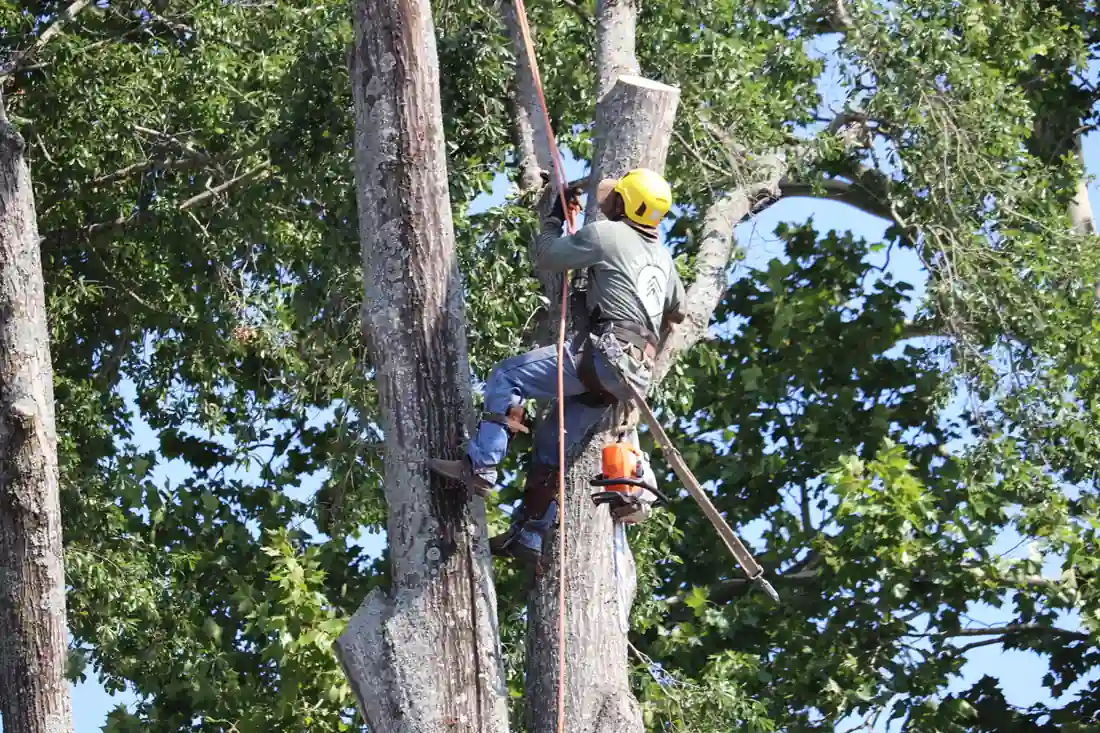
An Artmire's climber roped high between two dead oak trunks against blue sky
Reduction handles size, deadwooding handles risk
Crown reduction resizes an overgrown tree while preserving its health, and it is not topping. Topping chops limbs to stubs and invites decay and fast, weakly attached regrowth. Reduction shortens each limb back to a side branch large enough to take over as the new tip, so the tree keeps its natural shape at a smaller size. It suits a tree crowding a house, a roofline or a neighbor's fence.
Deadwooding removes the dead branches most likely to fall without warning. Dead wood sheds on calm days as easily as in storms, and it hangs over the places people use: patios, play sets, parked cars, driveways. Before a cut is made the crew does a hazard assessment, so we know where a falling limb will go and who or what is under it.
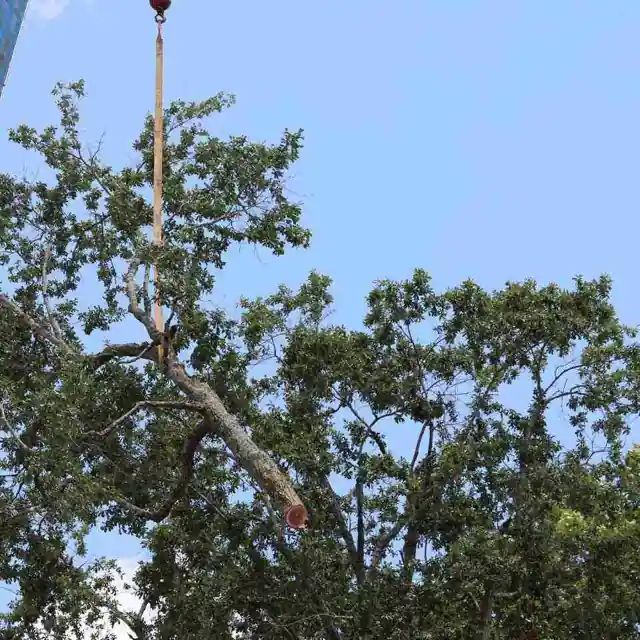
After a storm, the first limbs off are the hangers, broken pieces lodged in the canopy that can drop at the next gust. The crew works those out from above with rope and saw, or lowers them on the crane line, so the tree is safe to work under before anything else is touched.
Vista pruning, and how we choose among the five
Vista pruning shapes trees for a scenic view: a pond, a pasture, a stretch of the horizon from a deck. We open a window through the canopy by removing selected branches, not the whole top, so the tree stays healthy and the view is framed by foliage instead of a gap.
Which of the five a tree gets depends on what it is doing. The ISA Certified Arborist looks at species, age, structure and what sits under and around the tree, then quotes the work. Most jobs combine two, and deadwooding with thinning in a single visit is common. Estimates around Tyler are free, and the office number is (903) 581-4766.
Homes and commercial sites are handled differently: homes around family life, commercial lots around off-peak hours. Limbs leave with the crew, and wood from our jobs feeds the hardwood mulch and firewood we sell from our Tyler yard.
Artmire's Urban Forestry has been trimming Tyler trees since 1995 as a family-owned company. Fully insured: professional liability and workers' compensation, with certificates available on request.
The five cuts, filed
- Crown Thinning
- Selective branch removal to improve light and airflow.
- Crown Raising
- Clearing lower branches for visibility or clearance.
- Crown Reduction
- Resizing overgrown trees while preserving health.
- Deadwooding
- Removing hazardous dead branches.
- Vista Pruning
- Shaping trees for scenic views.
Trimming types we offerDet. ISA Certified Arborist